Introduction
A control valve can receive a changing control signal without producing the expected movement. The process variable may fluctuate around its setpoint, the valve may respond only after a noticeable delay, or the actuator may repeatedly move in small jumps instead of smoothly following the command.
These symptoms are often associated with deadband, hysteresis, or stiction. Although the terms are sometimes used interchangeably, they describe different aspects of valve behavior. Understanding the distinction helps engineers identify the actual cause of poor control rather than repeatedly adjusting the controller or replacing components unnecessarily.

1. What Is Control Valve Deadband?
Deadband is a range of input signal change over which the valve does not produce a detectable change in position or output.
For example, the control signal may increase slightly, but the valve remains stationary. A larger change may be required before the valve begins to move.
Deadband can result from mechanical backlash in linkages, looseness in mounting connections, friction, or the combined response of the actuator and positioner. In some cases, the problem is more noticeable when the direction of movement changes.
Excessive deadband can make small control adjustments ineffective. In temperature, pressure, or flow loops, this may cause the process variable to drift before the valve responds.
2. What Is Hysteresis?
Hysteresis occurs when the valve's position depends partly on the direction from which it approaches a given input.
For instance, the valve may reach one position while the signal is increasing and a slightly different position when the same signal is approached while the signal is decreasing.
Mechanical friction, elastic deformation, backlash, and other characteristics of the valve assembly can contribute to this behavior.
Hysteresis makes the relationship between control signal and valve travel less repeatable. This matters in applications requiring accurate modulation, particularly when the process operates within a narrow control range.
Deadband and hysteresis may appear together, but they are not identical. Deadband describes a range where an input change produces no detectable response; hysteresis describes a difference in response depending on the direction of approach.
3. What Is Stiction?
Stiction, or static friction, occurs when the force needed to start valve movement is greater than the force needed to maintain movement.
A valve affected by stiction may remain stuck while the control signal changes. Once the actuator force overcomes the friction, the valve suddenly moves. The process can then repeat, producing a stick-slip pattern.
Common causes include:
-
Excessive packing friction or incorrectly adjusted packing.
-
Corrosion, deposits, or contamination around moving components.
-
Worn or damaged actuator components.
-
Mechanical misalignment or poor mounting.
-
Positioner or pneumatic problems that prevent smooth actuator movement.
Stiction can lead to repeated process oscillations, unnecessary actuator movement, and increased wear. However, similar symptoms can also result from controller tuning, process disturbances, or unstable instrument air. Diagnosis should therefore consider the complete control loop.
4. How These Problems Affect Process Performance
The operational consequences depend on the application, but common effects include:
-
Process oscillation: The controller continues adjusting its output because the valve does not respond smoothly.
-
Reduced control accuracy: Small changes in the control signal fail to produce predictable changes in flow.
-
Increased energy consumption: Pumps, compressors, heaters, or cooling systems may work harder to compensate for unstable control.
-
Premature component wear: Repeated stick-slip movement can increase mechanical stress.
-
Unnecessary maintenance: Teams may replace positioners or actuators when the real problem is mechanical friction or installation.
These effects can be particularly significant in processes that depend on stable pressure, temperature, or flow regulation.
5. A Practical Troubleshooting Approach
Start by reviewing the control trend. If the controller output changes continuously while the process variable oscillates, compare the control signal with actual valve travel, where reliable position feedback is available.
Then inspect the valve assembly in a controlled maintenance procedure.
Check the mechanical components. Examine mounting connections, linkage backlash, packing condition, actuator movement, and signs of contamination or corrosion.
Review the pneumatic system. Confirm that the instrument air supply is stable and that tubing, fittings, and actuator connections are not leaking or restricted.
Evaluate the positioner. Verify configuration, travel feedback, input signal, and diagnostic information. A digital positioner can help distinguish between a position command and the valve's actual response.
Review controller tuning. If the mechanical and pneumatic systems operate correctly, investigate whether the control loop is too aggressive or responding to process disturbances.
Avoid using controller tuning to compensate for severe mechanical friction. It may temporarily reduce oscillation without correcting the underlying fault.
6. Can a Smart Valve Positioner Help?
Digital valve positioners can provide useful information about valve travel, input signal, actuator pressure, and diagnostic status, depending on the model and configuration.
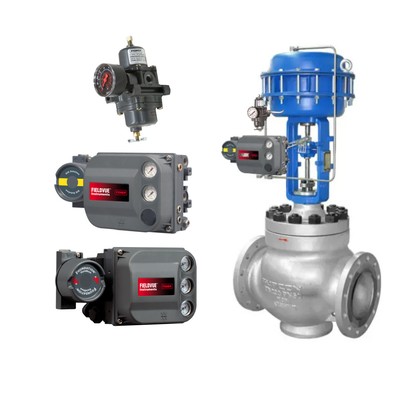
For example, Fisher FIELDVUE DVC6200 digital valve controllers can be used with supported diagnostic tools to assess valve performance. Similar evaluation may be possible with other digital positioners, including Masoneilan SVI and Neles ND9000 models, subject to their individual capabilities.
Diagnostics can help identify abnormal response, but they do not automatically prove that a valve has stiction. Results should be interpreted alongside process trends, mechanical inspection, and operating conditions.
Conclusion
Deadband, hysteresis, and stiction can all reduce control valve performance, but they describe different behaviors and may have different causes. Identifying the correct mechanism is essential for selecting an effective corrective action.
A systematic investigation of mechanical components, instrument air, positioner feedback, and controller tuning is generally more effective than replacing parts based on symptoms alone.
For persistent valve response problems, review the operating trends and valve configuration before deciding whether adjustment, maintenance, or replacement is required.


 Your message must be between 20-3,000 characters!