Pressure regulators are widely used to maintain a required downstream pressure in gas, steam, and liquid systems. However, not all regulators respond to pressure changes in the same way.
Two common designs are direct-operated and pilot-operated pressure regulators. Both regulate pressure without necessarily requiring an external electronic control loop, but they differ in how they generate the force needed to move the main regulating element.
Understanding these differences helps engineers select a regulator that matches the required flow capacity, pressure conditions, response characteristics, and maintenance needs.
1. How Does a Direct-Operated Pressure Regulator Work?
A direct-operated regulator uses the downstream pressure acting on a sensing element, such as a diaphragm or piston, to balance an adjustable spring force.
When downstream pressure changes, the sensing element moves and adjusts the main valve opening. The regulator therefore responds directly to the pressure it is designed to control.
This relatively straightforward arrangement can provide a compact solution with fewer components than many pilot-operated designs.
Direct-operated regulators are often suitable for applications with moderate flow requirements, less demanding capacity requirements, or installations where simplicity is a priority. Their performance still depends on the regulator design, pressure range, flow demand, and operating conditions.
One characteristic to consider is droop: downstream pressure may change as flow demand increases or decreases. The amount of droop depends on the regulator design and the conditions under which it operates.
2. How Does a Pilot-Operated Pressure Regulator Work?
A pilot-operated regulator uses a smaller pilot regulator to control the pressure acting on a main regulating element.
The pilot senses a pressure change and adjusts the control pressure supplied to the main valve actuator or diaphragm chamber. This allows the pilot to regulate the operation of a larger main valve without relying solely on the direct force generated by the downstream sensing element.
Depending on the design, pilot operation can support higher flow capacity and tighter pressure regulation over a broader range of demand than a comparable direct-operated design.
However, pilot-operated regulators typically have more components and additional sensing or control passages. Their performance can be affected by pilot-line restrictions, contamination, incorrect adjustment, or unsuitable installation.
Not every pilot-operated regulator has the same architecture. Some designs use internal pressure passages, while others require external sensing or control connections. The manufacturer's documentation should be consulted before installation or maintenance.
3. Key Performance Differences
The main differences are related to the force mechanism, system complexity, and operating requirements.
| Factor |
Direct-operated regulator |
Pilot-operated regulator |
| Operating principle |
Downstream pressure acts directly on the sensing element |
A pilot controls the main regulating element |
| Construction |
Generally simpler |
Generally more complex |
| Flow capacity |
Depends on regulator size and design |
Can support high capacity in suitable designs |
| Pressure regulation |
Droop may become more noticeable as demand changes |
May provide tighter regulation over a wider demand range |
| Response |
Direct and relatively simple pressure response |
Depends on pilot, main valve, and sensing arrangement |
| Maintenance |
Fewer components in many designs |
Additional pilot components and passages may require attention |
| Typical selection focus |
Simplicity, capacity, and operating conditions |
Capacity, regulation performance, and system requirements |
These are general design tendencies, not guaranteed performance rankings. A properly sized direct-operated regulator may outperform an unsuitable pilot-operated model in a particular application.
4. When Is a Direct-Operated

Regulator a Better Choice?
Direct-operated regulators are worth considering when the application does not require the additional capacity or regulation characteristics of a pilot-operated design.
Typical considerations include:
-
Moderate and relatively predictable flow demand.
-
A preference for simpler installation.
-
Limited maintenance resources.
-
Suitable upstream and downstream pressure conditions.
-
A regulator size that meets the required capacity without operating outside its intended range.
For example, a direct-operated pressure regulator may be appropriate for local gas pressure control or utility systems where its capacity and pressure-control performance meet the process requirements.
Before selecting the model, engineers should review inlet pressure, outlet pressure, minimum and maximum flow, gas or liquid properties, and the consequences of regulator failure.
5. When Should a Pilot-Operated Regulator Be Considered?
Pilot-operated designs are often considered when flow demand is high or downstream pressure must remain relatively stable over a wide operating range.
They may be appropriate for larger gas distribution systems, industrial pressure reduction stations, or other applications where the main valve requires pilot-assisted control.
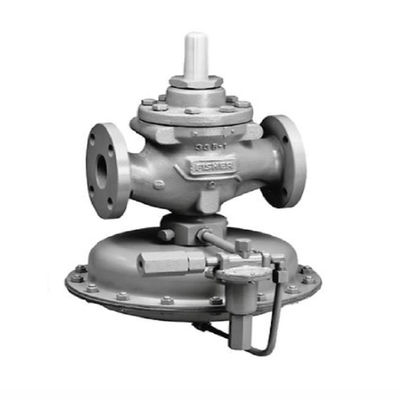
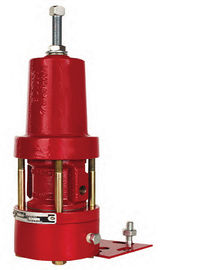
For instance, Fisher 1098-EGR pressure regulators are associated with pilot-operated pressure regulation in suitable gas applications. The exact configuration must be selected according to the required inlet and outlet pressures, capacity, and service conditions.
Pilot-operated designs may also require greater attention to pilot passages, sensing lines, filtration, and installation details. If the process medium contains contaminants, the effect on the pilot and associated restrictions should be assessed.
6. What Information Is Needed for Selection?
To compare regulator designs accurately, collect the following information:
-
Inlet pressure: Minimum, normal, and maximum supply pressure.
-
Required outlet pressure: The target pressure and acceptable variation.
-
Flow demand: Minimum, normal, and maximum flow rates.
-
Process medium: Gas, steam, or liquid, including relevant fluid properties.
-
Temperature: Normal and extreme operating conditions.
-
Pressure differential: The available pressure drop across the regulator.
-
Installation requirements: Pipe size, connections, sensing lines, and available space.
-
Safety requirements: Required response to regulator failure and any applicable overpressure protection.
For gas service, flow capacity and pressure regulation should be assessed using the manufacturer's sizing method. For steam or liquid service, the relevant fluid properties and possible operating limitations must also be considered.
A regulator should not be selected by nominal pipe size alone.
7. Common Selection and Maintenance Mistakes
Choosing by maximum flow alone: A regulator must also operate satisfactorily at minimum and normal demand.
Ignoring pressure variation: Inlet pressure changes can affect regulator performance, so the full operating range should be reviewed.
Overlooking pilot-line problems: A restricted sensing line or contaminated pilot passage can cause unstable regulation or delayed response.
Assuming all pilot-operated models behave alike: Different designs have different sensing arrangements, operating requirements, and failure characteristics.
Neglecting overpressure protection: The regulator's failure modes and the system's required protective devices must be assessed separately. A pressure regulator should not automatically be treated as a substitute for a safety relief device.
Conclusion
Direct-operated and pilot-operated pressure regulators serve similar purposes but use different mechanisms to control downstream pressure. Direct-operated designs often offer simplicity, while pilot-operated designs may provide higher capacity or tighter pressure regulation in suitable applications.
The best choice depends on pressure conditions, flow demand, required regulation performance, process medium, and maintenance capability. Reviewing these factors before procurement helps avoid poor pressure control and unnecessary operating problems.
Need help selecting a pressure regulator? Provide the inlet pressure, outlet pressure, process medium, and minimum, normal, and maximum flow requirements for a more focused assessment.


 Your message must be between 20-3,000 characters!