Product Overview
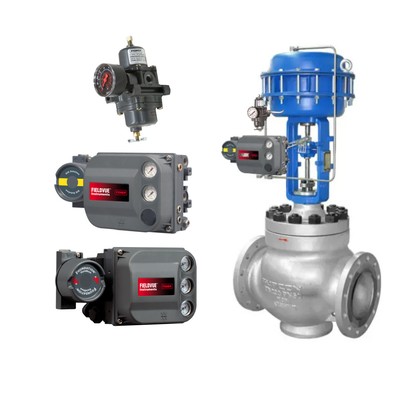
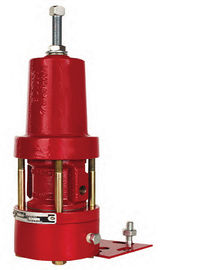
The Fisher 3720 is an electro-pneumatic valve positioner designed for use with diaphragm or piston rotary actuators. It consists of a 3710 pneumatic positioner combined with a 3722 electro-pneumatic converter. The converter receives a 4-20 mA DC input signal and produces a proportional pneumatic output (0.2 to 1.0 bar / 3 to 15 psig) that drives the pneumatic positioner stage.
The 3720 can be used in single-acting or double-acting configurations. The action can be switched between direct and reverse in the field. Zero and span adjustments are made by hand without tools. The modular construction allows a 3710 pneumatic positioner to be converted to a 3720 electro-pneumatic unit by adding the 3722 converter.
The positioner uses field-proven spool valve technology for accurate, fast-responding operation with high cycle life. It withstands severe plant vibrations. The case, components, and gasket materials are selected for harsh environments, with low copper aluminum alloy die castings for corrosion resistance. Positioner bleed air purges internal parts. With EPDM O-rings and input module diaphragm, the 3720 can be used in low-temperature and high-temperature applications, as well as in food and beverage, pharmaceutical, and tobacco processing where special materials are required.
Technical Specifications
| Parameter | Specification |
|---|---|
| Brand | Fisher |
| Communication Protocol | 4-20 mA DC analog |
| Input Signal | 4 to 20 mA DC constant current; split range 4-12 or 12-20 mA DC |
| Data Interface | Wired |
| Diagnostics | No |
| Maximum Supply Pressure | 10.3 bar (150 psig) or actuator rating, whichever is lower |
| Recommended Supply Pressure | 0.3 bar (5 psig) above actuator requirement |
| Maximum Output Pressure | 150 psi |
| Mounting Type | Actuator mounted; rotary (single or double-acting) |
| Operating Temperature | Standard Temperature, High Temperature |
| Position Control | Modulating |
| Supply Media | Air |
| Area Classification | Explosion Proof, Intrinsically Safe, Non-incendive, Dust |
| Certifications | CSA, FM, ATEX, IECEx, CUTR, Peso, KGS, INMETRO, NEPSI, RCM |
| Equivalent Circuit | 120 ohms shunted by three 5.6 V zener diodes |
| Maximum Steady-State Air Consumption | Standard spool: 0.80 std m³/hr (30 scfh) at 4.1 bar (60 psig) supply |
| Maximum Air Capacity (Double-Acting) | Standard spool: 13 std m³/hr (480 scfh) at 4.1 bar (60 psig) supply |
| Housing Material | Low copper aluminum alloy; 300 series stainless steel components |
| Action | Field-reversible between direct and reverse |
Application Industry
The Fisher 3720 is used in general industrial process control, including chemical processing, power generation, pulp and paper, and other industries requiring reliable rotary valve positioning. With EPDM seals, it can also serve food and beverage, pharmaceutical, and tobacco processing applications. It is suitable for both single-acting and double-acting rotary actuators.
Common Problems
No output signal with input present: Check for clogged nozzle. Clean the nozzle. Check air supply pressure.
Slow or abnormal output pressure: Check supply pressure is within specification. Check the pneumatic amplifier and nozzle/flapper assembly.
Linear response poor: Check the zero spring adjustment. The zero spring has a limited linear working range. Check the range adjustment mechanism position.
Positioner does not respond: Verify supply pressure and pneumatic connections. Check that the converter is receiving the 4-20 mA signal.
Air leakage: Check O-rings, gaskets, and diaphragm for wear. Replace as needed.
Replacement Models
The Fisher 3720 is a mature electro-pneumatic positioner platform. For modern digital communication and advanced diagnostics, the Fisher DVC6200 or DVC2000 digital valve controllers are the current-generation alternatives. For legacy installations, the 3720 serves as a direct replacement for the 3710 pneumatic positioner when electrical input is required. For cross-vendor alternatives, verify actuator mounting, travel range, and input signal compatibility before ordering.
Overall Rating
Rating Snapshot
The following is the distribution of all ratingsAll Reviews